


Decades have gone by since the conversation surrounding the gender pay gap crept into common vernacular. And, while it’s shrunk over the last two decades - in 2024, the average woman earns 83 cents for every dollar the average man makes - a significant difference still persists.
Thus, the real question here is not whether the pay gap exists, or even whether it should exist. The real question is should we care that it exists?
American culture has become atomized to the point that we view the individual as the fundamental unit of society, an attitude that even shapes how we view social justice issues. The pay gap is the perfect example: when we discuss this issue, we justify or bemoan its existence by arguing from the perspective of the individual. Should the average woman (individual) earn the same as the average man (another individual) for the same type of work?
Yet, herein lies the real problem with this debate. Society isn’t a collection of individuals. The fundamental building block of any culture can’t be the individual person because individuals do not create new human life. Individuals don’t reproduce. Families do that.
Interestingly, the pay gap reflects this fact with crystal clarity.
The gender pay gap does not exist for single, childless adults. In fact, as of 2022, unmarried childless women earn slightly more than unmarried childless men: $87,200 versus $82,100 annually.
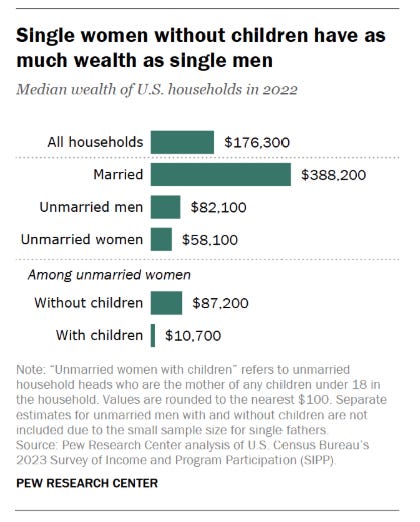
So, what populations are skewing the data so much to cause that 83 cents statistic we see touted as proof that women are still being unfairly compensated in the workplace? The skew is from families.
Married women with children earn 35% less on average than married men with children. Yet, unmarried women have it the hardest financially, making an average of $11,000 a year.
Some may dig their heels in, claiming that whether kids are in the picture or not, women should still be fairly compensated for their work. Of course, no one is advocating for sex discrimination in the workplace - at least, no one I’ve ever met or heard speak on this issue. Yet, if you talk to families headed by married parents, the story shifts significantly away from “fair compensation” to “what’s best for the family”.
Women, for primarily biological and psychological reasons, are more likely to have the temperament, skillset, and desire to stay home with their small children. To argue that this reality is completely or even mostly socially constructed is to ignore every sign that nature gives us about the importance of having mom actively involved as the primary caretaker of her babies. The vast majority of mammalian species follows this arrangement. For example, for our closest ancestors, chimpanzees, it’s customary to see the mama chimp play the role of active, hands-on primary caretaker for her young for at least 10 years.
The hormonal evidence for this sex difference when children come into the picture is also overwhelming. Through pregnancy and breastfeeding, it’s not just a woman’s body that changes to accommodate this new life she’s bringing into the world. Her hormones change the makeup and size of her brain, as well, to better suit the needs of her infant. And, while men’s hormones also change to make them better caretakers, their hormones encourage a shift into the role of caring more for the family as a unit rather than the baby as an individual. For example, a drop in testosterone helps men focus more on providing for and protecting their wives and children rather than on risk-taking behaviors better suited for the single man’s lifestyle.
I’ll never forget the day my husband experienced this change firsthand when I gave birth to our first child. About our investment strategies, he said, “I’ve always been risk averse. But, now I am the most risk averse.” It made me smile knowing that we were both changing in exactly the ways we were supposed to so that we could be good parents.
So, what does all of this mean for the pay gap? It means that women with children work less because they want to (and should) spend more time with their kids, particularly for the first three to five years of life. Men, on the other hand, choose to work more once they have kids in order to allow their wives to work less and care for their children. Thus, even full-time working mothers see significantly less pay than full-time working fathers because mothers choose more flexible work options in lower stress industries, work fewer hours overall, and take more time off than men do. The consequence of these choices is lower pay, a consequence I would argue is well worth it when you consider the tremendous benefits to everyone in the family (including moms!) when men and women are encouraged to embrace the natural changes in their desires and roles that they experience when they become parents.
In other words, the real pay gap is a mother gap. What’s wrong with this arrangement? Nothing, if you view society as a collection of families and care primarily about promoting social practices and economic policies that are best for the family. A problem only arises when we (wrongly) view society as a bunch of individuals who should all be behaving similarly and, thus, achieving similar outcomes. Yet, this never has and never will be the case. By design, families function significantly differently from individuals. And, since the family is the necessary ingredient for any society to thrive, it’s also the unit that should be protected at all costs.
Stay strong, mamas and papas. You’re doing the Lord’s work!
~ Cameron